Nederlands
 Français
 Deutsch


Why are teeth sometimes not getting whiter during a whitening treatment?
Sometimes teeth are not getting whiter or the result is smaller than expected. That does not automatically mean there is something wrong with the whitening gel, the whitening lamp or the treatment itself.
Besides a good gel, a suitable whitening lamp and a correct treatment protocol, we need one more very important thing:
discolouration!
The more bleach-responsive discolouration that is actually present in the teeth, the greater the visible difference may be.
Think of a bottle of cola
Imagine a bottle that can hold one litre of cola.
If it contains one litre, you can take one litre out.
If it only contains half a litre, you can never take a full litre out.
And if the bottle is almost empty, there is very little left to remove.
Teeth whitening works in a similar way: you can only affect discolouration that is actually present.
In simple terms, teeth whitening works by chemically changing or breaking down colour molecules associated with discolouration, making the teeth appear lighter.
The difference with the cola bottle is that we cannot look inside a tooth. We therefore cannot see in advance exactly how much bleach-responsive discolouration is present.
That is why you can never reliably promise that a client will become exactly five, eight or ten shades lighter.
Dark teeth do not automatically mean more result
A tooth may look dark because there is a lot of discolouration present, but it may also look darker because the natural colour of the underlying dentine is warmer, more yellow or naturally darker.
Two clients can therefore start with a very similar tooth shade and still respond very differently to whitening.
One client may show a clear change quickly, while another may achieve a much more limited result.
That does not necessarily mean the treatment has failed.
The starting shade can still give useful clues
Although we cannot look inside the tooth, the starting shade can help us make a professional estimate of how the teeth may respond.
In general, we often see the following in practice:
- Yellow to dark yellow: often responds well and can show a clearly visible change.
- Yellow-brown or brown: can also respond well, although the result depends strongly on the cause and depth of the discolouration.
- Grey or blue-grey: is often more difficult and less predictable and may not respond as quickly or strongly as yellow discolouration.
- Already very light teeth: usually have less visible room for improvement because there may simply be less discolouration present.
A single tooth that is noticeably grey, very dark or almost black is a different situation. This should not simply be cosmetically whitened. A major colour difference in one tooth can have a dental cause and should first be assessed by a dentist.
The starting shade therefore provides useful information, but it remains an estimate, never a guarantee.
Some teeth simply have less whitening potential
Clients who naturally have light teeth or who regularly have their teeth whitened often have less visible discolouration remaining.
It is therefore logical that a later treatment may produce a smaller visible difference.
This is exactly why we believe in discussing realistic expectations before treatment and never promising an exact number of shades. That simply cannot be guaranteed.
Always check the treatment protocol first
If the result is less than expected, first check whether the entire treatment is being performed correctly:
whitening gel → correct amount → even application → treatment time → number of rounds → whitening lamp → distance and position → product storage
Using more gel, extending the treatment time or simply adding extra rounds is not automatically the solution.
Pink and Booster can respond differently
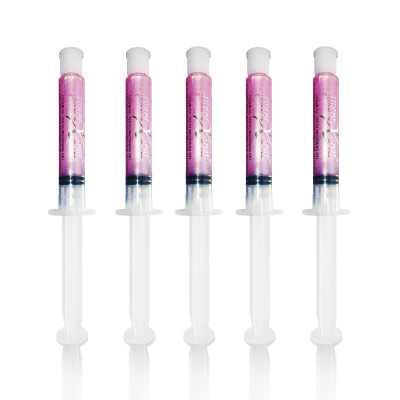
Within our cosmetic treatments, we work with X-treme Smile Pink, based on sodium percarbonate, and X-treme Smile Booster, based on PAP.
In practice, we see that some clients appear to respond better to Pink, while others respond better to Booster. We cannot reliably predict in advance which gel will produce the greatest change for a specific client.
That is why many professionals keep both products available.
If the result is limited after one or two rounds, it may be useful to switch from Pink to Booster or from Booster to Pink.
This can sometimes produce additional improvement, but it is never a guarantee of a specific number of extra shades.
Measure the starting shade
Before treatment, use a dedicated teeth whitening shade guide and record the starting shade. This makes it easier to assess objectively how much change has actually occurred during and after treatment.
Before-and-after photos can also help, as long as they are taken under conditions that are as similar as possible:
same lighting → same position → same distance → no filters
This matters because your eyes quickly become accustomed to the changing tooth colour during treatment.
When should you stop?
If the treatment protocol has been followed correctly and the teeth are hardly changing any further, treating for longer or more intensively is not automatically professional.
Sometimes you have simply reached the result that is realistically achievable for that client at that moment.
That is an important part of professional knowledge: not only knowing how to continue treating, but also recognising when further treatment is unlikely to add much.
In short
Why are teeth not always getting as white as expected?
Because the result is largely determined by how much bleach-responsive discolouration is actually present in the teeth.
The starting shade can help us make an initial assessment, but we cannot look inside the tooth. We therefore never know in advance exactly how much discolouration is present or how strongly the teeth will respond.
If the result is limited, first check the complete treatment protocol and assess how the teeth respond during treatment. Where appropriate, you can switch between Pink and Booster within our cosmetic protocols.
The goal is not to make every client a predetermined number of shades lighter, but to achieve the best realistic result for those specific teeth.