
 Nederlands
 Français
 Deutsch


Professional knowledge about gold tooth jewellery
Gold tooth jewellery combines a luxurious appearance with an adhesive technique on the tooth surface. Professional application therefore requires not only an eye for design, but also knowledge of gold alloys, size, weight, contact surface, bonding, placement and oral hygiene.
On this page, X-treme Smile® shares professional knowledge about gold dental jewellery: from 18K, 22K and white gold to professional bonding, design mapping, retention, aftercare and responsible removal.
What is gold tooth jewellery?
Gold tooth jewellery consists of small decorative pieces made from a gold alloy that can be bonded to the visible surface of a natural tooth using a suitable dental adhesive system. With adhesive placement, there is no need to drill into the tooth structure.
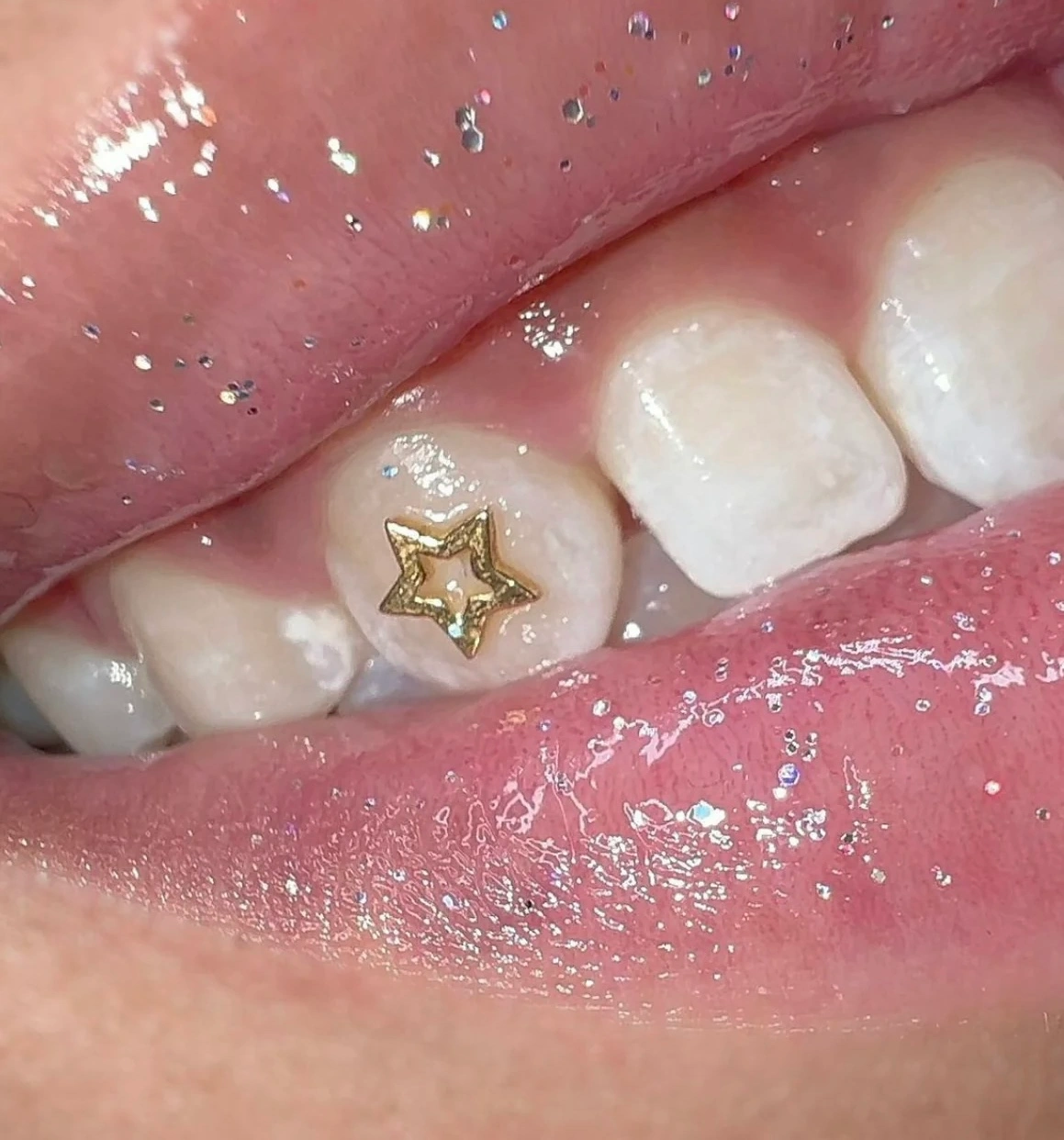
Internationally, they are commonly referred to as gold tooth jewellery or gold dental jewellery. The term gold tooth gems is also used. Gold tooth jewellery differs materially from crystals within professional tooth jewellery. Unlike a grill or crown, a small piece of gold tooth jewellery is bonded to the tooth surface rather than covering the entire tooth.
Shapes can vary considerably, from small hearts, stars, moons and geometric forms to more striking designs. Appearance is important, but the back surface, contact area, weight and position on the tooth are also relevant to successful placement.
Not every small gold ornament is automatically suitable for use as tooth jewellery. For professional use, the design must be suitable for controlled adhesive bonding to a tooth surface.
What is the difference between 18K, 22K and white gold tooth jewellery?
The karat value indicates how much of a gold alloy consists of pure gold. Pure gold is 24 karat. In jewellery, gold is usually alloyed with other metals to influence properties such as colour, hardness and workability.
18 karat gold
18 karat corresponds to a gold content of 750/1000, or 75%. The remaining 25% consists of alloying metals that influence properties such as colour, hardness and workability. The exact composition can vary between gold alloys.
An independently tested sample of our 18K gold tooth jewellery measured 76.3% gold, 11.5% silver, 11.6% copper and 0.6% zinc. Product-specific safety documentation is also available for 18K gold tooth gems with this composition.
22 karat gold
22 karat theoretically corresponds to approximately 91.7% gold. According to the product specification for our 22K yellow gold tooth jewellery, this version consists of 92% gold, 6% silver and 2% copper.
Because of its higher gold content, 22K generally has a warmer, deeper gold colour and is softer than many 18K alloys.
18 karat white gold
According to the product specification for our 18K white gold tooth jewellery, this alloy consists of 75% gold, 12.5% silver and 12.5% copper. Zinc and nickel are not listed in the stated composition.
The fact that a metal is not listed in a product specification is not the same as analytically demonstrating that the product is completely free from that metal. Because alloy compositions can vary by product, reliable material information remains important, particularly in cases of known metal allergies or previous material reactions.
Is a higher karat value automatically better?
No. A higher karat value mainly means that the proportion of gold is greater. By itself, it does not mean that a piece of tooth jewellery will bond better or remain in place longer. The shape of the jewellery, contact surface, placement, bonding protocol and mechanical load are more important factors.
Do not choose gold tooth jewellery on karat value alone. For professional use, the material, shape, back surface, dimensions and intended application must be suitable as a whole.
Tested material composition and safety documentation
At X-treme Smile®, we have product specifications for various gold alloys, an independent component analysis of an 18K gold sample and product-specific safety documentation for 18K gold tooth gems described as dental decoration. The document supplied by the supplier is referred to as an MSDS. In a European context, the term Safety Data Sheet (SDS) is generally used for this type of safety document. This documentation provides information about the stated composition and safety information; the other alloying metals may vary between product versions.
The independent analysis relates to one tested 18K sample. We therefore do not use these measurements to claim that every 18K item contains exactly the same percentages. The product specification for the relevant version remains the primary reference.
For the documented 18K gold tooth gems, the available safety document states the same composition: 76.3% gold, 11.5% silver, 11.6% copper and 0.6% zinc. The document also includes an assessment under the US OSHA/GHS framework referenced in that document.
The available safety document also contains information on matters including stability and the hazards assessed within that document. Such documentation is relevant to product safety and material information, but does not in itself constitute a complete clinical biocompatibility assessment for long-term intraoral use. Product-specific instructions for use, material information and professional application therefore remain the primary references.
Why is there no gold hallmark on our gold tooth gems?
Each of our individual gold tooth gems weighs less than 1 gram. In the Netherlands, a hallmark is required for gold articles weighing 1 gram or more when they are offered for sale. Because these small pieces of tooth jewellery remain below that weight threshold, the individual item is not subject to mandatory Dutch hallmarking on the basis of this weight threshold.
The absence of a hallmark on a gold article weighing less than 1 gram therefore does not automatically mean that it is not genuine gold. For material composition, we refer to the product specification and, where available, additional independent analysis and safety documentation. For example, a tested 18K sample of our gold tooth gems measured 76.3% gold.
This weight exemption relates specifically to Dutch precious-metals regulations. Different national requirements may apply to sale or use in other countries.
Solid gold is different from gold-plated
A solid gold piece of tooth jewellery consists throughout of a gold alloy with the stated karat value. A gold-plated item consists of another base material covered with only a thin layer of gold. These are materially different products. Always check which material type and alloy composition are actually documented for each product.
For professional gold dental jewellery, always check whether the product is solid gold or gold-plated, and which karat value and material composition are specified for that particular product.
What is the difference between gold tooth jewellery and tooth gems?
Both crystals and gold tooth jewellery can be adhesively bonded to natural tooth enamel, but they do not behave in exactly the same way. A small crystal usually has a different shape, mass and underside from a piece of gold jewellery.
Crystals
Crystals are usually small and lightweight. They are available in many sizes, colours and shapes and can be used individually or in clusters.
Gold tooth jewellery
Gold pieces may be larger, heavier or shaped differently. This means that contact surface, fit, edge shape, bite and mechanical loading require extra attention.
The same basic principles of isolation and adhesive bonding remain important, but a professional assesses each piece individually. A protocol that works well technically for a small round crystal does not automatically create the same practical conditions for a larger gold design.
How is gold tooth jewellery professionally applied?
Gold tooth jewellery is adhesively bonded to a suitable natural tooth surface. The basic process consists of selecting the tooth and position, cleaning and isolating, controlled enamel preparation, applying the chosen dental bonding system, accurate placement and complete curing.
The exact steps, products and working times vary by system. Not every adhesive system or gold shape is automatically suitable for the same technique. Always follow the instructions for use for the bonding material, the jewellery and the curing light being used.
Assess the tooth, jewellery and position
Check whether the tooth surface is suitable and assess the shape, size, back surface, contact area and desired position of the jewellery at the same time.
Clean and isolate the tooth surface
The working area must be clean and kept as free as possible from saliva and other moisture during critical bonding steps.
Prepare the enamel
Etching and any subsequent steps must be performed strictly according to the selected dental adhesive system.
Apply primer or adhesive
Apply the prescribed components in the correct order and amount. Different systems are not automatically interchangeable.
Position the bonding material and gold jewellery
Position the jewellery accurately and check that it sits stably against the selected tooth surface before the material is fully cured.
Cure completely
Polymerise the light-cured bonding material with a suitable dental curing light according to the instructions for the material and the light. Gold is opaque: curing light cannot pass through the gold to reach bonding material directly beneath the metal jewellery. The selected material and protocol must therefore be suitable for this application and for the available light access around the jewellery.
Check finishing, bite and cleanability
After curing, check the edges, position, stability, available cleaning space and any mechanical loading when the client bites together.
What determines the bond of gold tooth jewellery?
Bond strength depends on the complete combination of tooth surface, isolation, bonding protocol, jewellery, positioning and curing.
The surface properties of the back of the gold jewellery are also relevant to the adhesive starting conditions. A very smooth or unsuitable metal surface does not become reliably bondable simply by using more bonding material. Use jewellery intended for adhesive tooth-jewellery applications and follow the product-specific protocol for the system being used.
With gold tooth jewellery, “more glue” is not the solution to an unfavourable fit or position. Reliable placement starts with suitable jewellery, a suitable tooth surface and a correctly performed adhesive protocol.
Why are size, weight and contact surface important?
Gold tooth jewellery can vary considerably in size and shape. This also changes how the jewellery sits on the tooth and which forces may act on the placement during eating, speaking, brushing and biting together.
Larger jewellery is not automatically better
A larger design may provide more surface area, but it may also protrude further, be heavier or be more likely to encounter mechanical contact.
A small contact area requires extra attention
When only a small part of the back surface actually contacts the tooth, positioning becomes more critical.
The tooth surface is curved
A tooth surface is not flat. A large or rigid piece may therefore fit differently from a small crystal.
Edges must remain cleanable
The design must remain sufficiently accessible for daily oral hygiene and should not be assessed on appearance alone.
Professionally selected gold tooth jewellery should suit not only the desired look, but also the available space, tooth curvature, bite, comfort and cleanability. Also check that hard corners or protruding parts are unlikely to cause unnecessary irritation of the lip, cheek or gums.
How does design mapping work for gold tooth jewellery?
Design mapping means determining before bonding how a design fits the dentition both aesthetically and technically. With gold, this is particularly important because shapes are often larger or more asymmetrical than round crystals.
Design mapping is a preliminary cosmetic and technical design assessment. It does not replace a dental diagnosis when there is doubt about the health or condition of a tooth, the gums or other oral tissues.
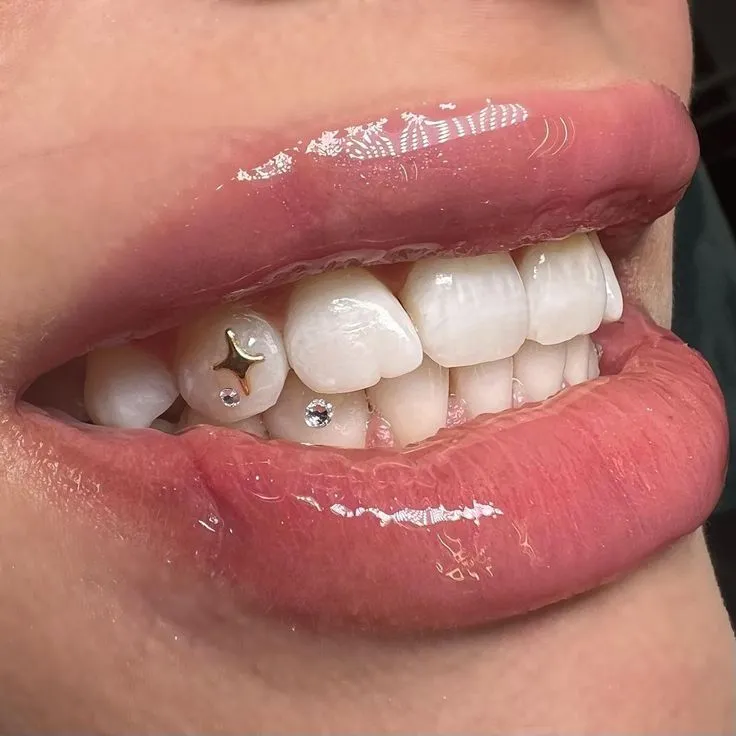
Assess the dentition as a whole
Consider tooth shape, tooth position, smile line, spacing between teeth and the proportion of the jewellery in relation to surrounding teeth.
Check the bite
Ask the client to bite together gently and assess whether the chosen design may contact teeth in the opposing arch.
Assess the underside
Before placement, check how the jewellery sits against the tooth and where the actual contact surface is created.
Leave space for cleaning
Do not position a design so close to the gums, contact points or other jewellery that daily cleaning becomes unnecessarily difficult.
Check edges and protruding parts
Assess whether the design has sharp, hard or clearly protruding parts that may continually press or rub against the lip, cheek or gums. An aesthetically attractive design should also be comfortable and practical to wear.
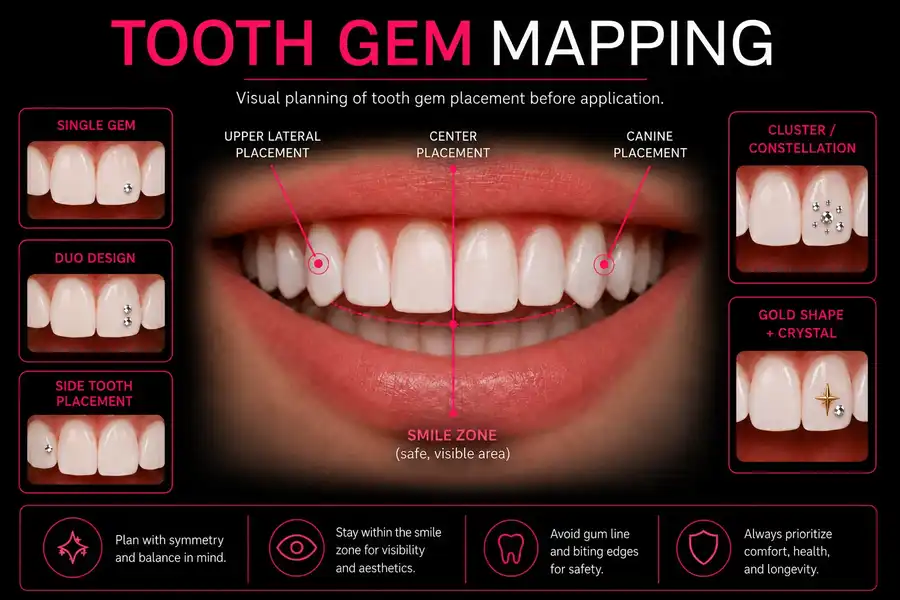
Combining multiple pieces
Gold tooth jewellery can be combined with crystals or other gold shapes. The more elaborate the design, the more important it becomes to check in advance that each element has sufficient space, can be placed correctly on its own and that the final result remains cleanable.
Good design mapping is therefore not simply “checking where it looks good” beforehand. It is a technical preparation in which aesthetics, contact surface, bite, loading, comfort and oral hygiene come together.
How long does gold tooth jewellery stay in place?
It is not possible to predict exactly how long gold tooth jewellery will remain in place. Retention depends on factors including the tooth surface, bonding protocol, shape and weight of the jewellery, position, bite, eating habits, oral hygiene and aftercare.
Gold tooth jewellery is adhesively bonded and therefore remains a non-permanent addition to the tooth surface. Even correctly placed jewellery may come loose over time.
Biting directly into hard or tough foods, playing with the jewellery or repeated loading from the bite can place additional force on the bonded item.
Do not promise a fixed lifespan. Professional practice means optimising the conditions for good retention and clearly explaining which factors may affect it afterwards.
What aftercare should be given for gold tooth jewellery?
The basic aftercare is similar to that for other adhesively bonded tooth jewellery: keep the tooth surface around the jewellery clean and avoid unnecessary mechanical loading.
Practical aftercare for the client:
- Continue to brush the tooth and the edges around the jewellery carefully.
- Continue to clean between the teeth as normal.
- Do not pick, pull or pry at the gold jewellery.
- Do not use fingernails or sharp objects to test whether it is still secure.
- Where possible, avoid biting hard foods directly on the jewellery.
- Never use nail glue, superglue or any other non-dental adhesive if the jewellery becomes loose.
- Have residual bonding material or partially loose jewellery assessed professionally.
- Do not attempt to reattach partially loose jewellery yourself.
- A completely detached piece may be swallowed; choking or breathing difficulties require immediate medical assessment.
Does bonding material still need 24 hours to dry?
Correctly light-cured bonding material is polymerised during the treatment. It therefore does not need another 24 hours to “dry” in the air. It is still sensible to avoid unnecessary heavy loading immediately after treatment and to brush carefully.
Always follow any additional aftercare instructions for the bonding material or bonding system used. The manufacturer's product-specific instructions for use remain the primary reference.
A gold design that cannot be kept adequately clean is not a good professional design. Oral hygiene should therefore already be considered during design mapping.
What risks and considerations are associated with gold tooth jewellery?
Adhesively bonded gold tooth jewellery is a cosmetic addition to the tooth surface and is not completely free from risk. Careful client and tooth selection, good oral hygiene, a technically suitable position, correct placement and professional aftercare help reduce avoidable risks.
Plaque and cleanability
Every piece of tooth jewellery creates additional edges and transitions. If these cannot be kept adequately clean, plaque may accumulate more easily and contribute to caries and gum problems.
Mechanical loading
An unfavourable position, sharp edge or direct contact with an opposing tooth can place additional load on the jewellery, the bonding material or surrounding tissues.
Detachment
Adhesively bonded jewellery can come loose. A small detached piece may be swallowed, and choking or breathing difficulties require immediate medical assessment.
Improper removal
Prying, scraping, grinding or attempting removal with unsuitable instruments may damage the tooth surface or surrounding tissue. Any remaining bonding material should also be assessed and finished in a controlled manner.
How is gold tooth jewellery removed?
Gold tooth jewellery that is firmly bonded should not be pried off the tooth with fingernails, tweezers, pliers or other objects. When active removal is required, both the jewellery and any bonding residue should be removed in a controlled manner while preserving as much of the natural tooth surface as possible.
When gold jewellery comes loose, bonding material may remain on the tooth. Removing the metal alone therefore does not mean that the tooth surface has been fully finished.
We recommend having firmly bonded gold tooth jewellery and any bonding residue assessed and, where necessary, removed by a dentist or another oral healthcare professional who is appropriately qualified and competent to perform the procedure. They can assess how the jewellery and remaining bonding material can be removed in a controlled manner and whether the tooth surface should then be finished or polished.
Do not do the following when removing tooth jewellery:
- Do not pry it loose with fingernails, tweezers or pliers.
- Do not file or grind bonding residue yourself.
- Do not use household solvents or chemicals.
- Do not rebond over unknown or irregular old bonding residue.
When should gold tooth jewellery not be applied?
If there is any doubt about the health or condition of the tooth, enamel, gums or oral tissues, do not apply gold tooth jewellery until the situation has been assessed by an appropriate oral healthcare professional.
Toothache or unexplained sensitivity
Do not proceed with cosmetic treatment despite symptoms. A cosmetic practitioner does not make a dental diagnosis.
Possible caries, fracture or damage
Do not place jewellery over an abnormal or damaged surface when the cause is unclear.
Insufficient oral hygiene
Gold tooth jewellery creates additional edges. If plaque is already a clear problem before treatment, oral hygiene should be improved first.
Unhealthy or irritated gums
Red, swollen, bleeding or irritated gums are a reason for caution and, when in doubt, professional assessment should be advised first.
Unfavourable bite
Do not place gold in a position where an opposing tooth repeatedly makes direct contact with it.
Crowns, veneers and composite restorations
A standard protocol for natural enamel is not automatically suitable for restorative materials with different surface properties.
Orthodontic appliances
Braces, brackets and retainers can affect space, cleanability and mechanical loading. If in doubt, consult the client's treating oral healthcare professional.
Unknown material reaction or allergy
Ask about known metal allergies, material allergies and previous adverse reactions. Not only the gold content, but also the other alloying metals and the dental bonding materials used may be relevant.
If in doubt, always check the product specification and instructions for use for the relevant jewellery and bonding system before treatment.
Screening is not the same as diagnosing
During the consultation, a cosmetic tooth gem artist can observe whether the teeth, gums and oral tissues appear normal and suitable for the treatment. This is screening and client selection.
Determining the cause of toothache, a white or brown spot, damage, gum problems or another abnormality requires dental assessment. If there is doubt, treatment should be postponed and the client referred to an appropriate oral healthcare professional.
Professional practice also means deciding not to treat. Screening and selection are part of a cosmetic treatment process; diagnosis belongs with an appropriately qualified oral healthcare professional.
How do you work hygienically and safely with gold tooth jewellery?
Gold tooth jewellery is applied in and around the mouth. The same basic infection-prevention principles therefore apply as with other professional tooth gem treatments.
Basic rules:
- Perform hand hygiene before putting on gloves and immediately after removing them.
- Use new gloves for every treatment and replace them if they become damaged or contaminated.
- Use single-use applicators only once.
- Use a clean applicator for each product step.
- Never place used applicators back into product containers.
- Keep clean and used materials separate.
- Clean and disinfect relevant contact surfaces between clients.
- Reprocess reusable instruments according to their intended use and the manufacturer's instructions.
- Prevent saliva contamination during critical bonding steps.
- Store and handle gold tooth jewellery in a clean and organised manner.
Reusable instruments
Reusable instruments that come into contact with oral mucosa must be properly cleaned and reprocessed between clients according to their intended use and the manufacturer's instructions. Heat-resistant instruments suitable for sterilisation should be sterilised after cleaning using an appropriately validated sterilisation process. If an instrument cannot be safely reprocessed, use an appropriate single-use or safely reprocessable alternative.
Keep the gold jewellery clean as well
Do not simply place a piece of jewellery on the tooth if, before placement, it has come into contact with a contaminated work surface, the floor or used instruments. Work from a clearly defined clean zone and use a suitable clean pick-up tool or applicator.
Learn to work professionally with gold tooth jewellery
Working with gold tooth jewellery requires more than mastering standard crystal placement. A tooth gem artist must learn to assess how shape, size, weight, contact surface, tooth shape and bite interact and influence placement.
Material & karat
Understand the differences between gold alloys and why karat value is not the same as technical suitability for adhesive placement.
Design mapping
Learn to assess before bonding where a gold shape fits best both aesthetically and technically.
Bonding & placement
Work in a controlled manner with isolation, tooth surface preparation, bonding material, positioning and curing.
Recognising professional limits
Learn when a tooth, bite, oral hygiene, restoration or other factor is a reason not to place jewellery or to refer the client first.
Within the X-treme Smile® Academy, advanced professional training in gold tooth jewellery forms part of the Advanced Tooth Gem pathway. It builds on a solid foundation in crystal placement and adhesive technique.
Advanced training in gold tooth jewellery
From material selection and design mapping to placement, bonding, aftercare and professional limits, gold dental jewellery requires its own technical approach within the tooth gem profession.
View courses & masterclassesProfessional gold tooth jewellery
X-treme Smile® offers gold dental jewellery for professional use. In our central category, you will find 18K and 22K yellow gold tooth jewellery as well as 18K white gold tooth jewellery in a variety of shapes and designs.
18K yellow gold
Professional 18 karat gold shapes for a wide range of tooth jewellery designs, with a classic gold colour and a variety of shapes.
22K yellow gold
Gold dental jewellery with a higher gold content and a warmer, deeper gold colour.
18K white gold
White gold designs in 18 karat for professionals who want to offer a cooler-toned metal appearance alongside yellow gold.
Knowledge based on dental background and practical experience
With gold tooth jewellery, we look beyond the final appearance. Professional placement also requires attention to the tooth surface, adhesive technique, contact area, design mapping, bite, cleanability, hygiene and the limits of cosmetic treatment.
At X-treme Smile®, we combine practical experience with an educational background in dentistry-related fields including dental assisting, dental technology and oral hygiene.
- Dental educational background
- Practical experience with tooth gems and gold tooth jewellery
- Knowledge of dental adhesive materials
- Focus on design mapping and contact surface
- Practice-oriented knowledge of isolation, curing and aftercare
- Personal support after training
Professional knowledge base
This knowledge is based on our own practical and training experience, product specifications, available material and safety documentation including an independent component analysis and a safety document described by the supplier as an MSDS, instructions for use for professional dental materials, Dutch precious-metals regulations and relevant professional guidance on oral hygiene, infection prevention and adhesive dental materials.
Manufacturers' product-specific instructions for use always remain the primary reference. Laws and regulations may vary by country. If there is any doubt about the health or condition of the teeth, gums or oral tissues, assessment by an appropriate oral healthcare professional is advised before treatment.