
 Nederlands
 Français
 Deutsch


Professional knowledge about teeth whitening
Professional teeth whitening involves more than simply applying a whitening gel. A good treatment protocol starts with assessing the condition of the teeth and the starting shade, followed by appropriate preparation, product selection, application, monitoring and aftercare.
On this page, X-treme Smile® shares professional knowledge about teeth whitening: from whitening gels and active ingredients to whitening lamps, treatment methods, results and safe professional practice.
What is professional teeth whitening?
Professional teeth whitening is a cosmetic treatment that reduces discolouration of natural teeth so that the teeth can appear lighter.
The colour of a person's teeth is determined by both their natural tooth shade and discolouration that develops over time. Every set of teeth has its own natural colour. Some teeth are naturally slightly more yellow, warm-toned or darker without there necessarily being significant staining.
Teeth can also become discoloured over time due to factors such as coffee, tea, red wine, food, smoking and ageing. The type and origin of discolouration can also vary.
Professional teeth whitening therefore involves more than simply looking at how dark or yellow the teeth appear. The starting shade, the amount of actual discolouration, the type of discolouration and the condition of the teeth are all important when assessing the result that can realistically be expected.
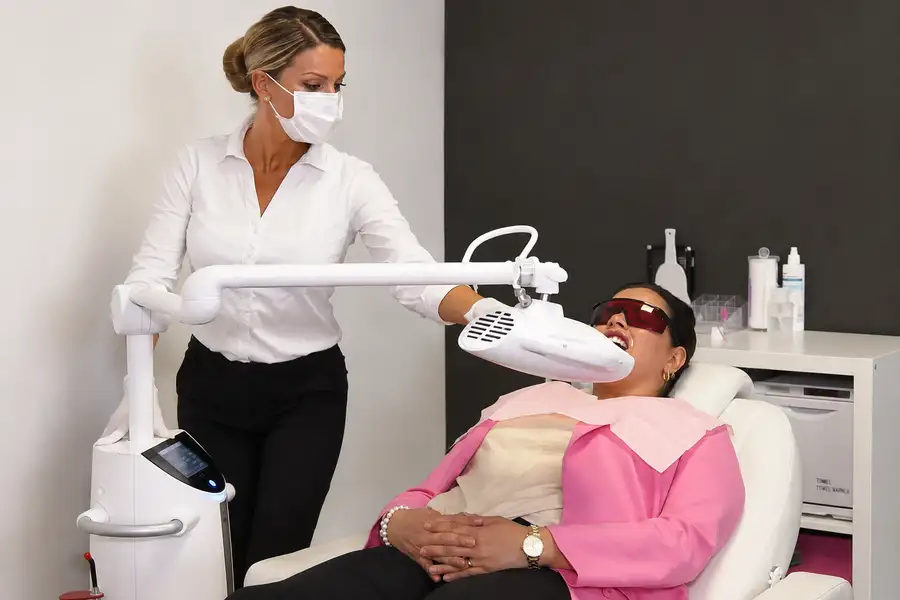
Important to remember: natural tooth shade and discolouration are not the same thing. The more actual discolouration that is present, the more visible colour change may generally be achievable.
How does teeth whitening work?
At its core, teeth whitening works by breaking down colour-producing compounds that make the teeth appear darker. A whitening gel contains an active ingredient that affects these compounds, making discolouration less visible so the teeth can appear lighter.
But besides a good whitening gel, sufficient treatment time and a correctly performed treatment protocol, one other factor is essential for a visible whitening result: there must actually be something to whiten.
The darker or more discoloured the teeth are at the start, the greater the visible colour change can generally be. Teeth that are already very light simply have less room for a dramatic colour change.
Discolouration and natural tooth shade are not the same
Every set of teeth has its own natural shade. Teeth can naturally be slightly more yellow, warm-toned or darker without this necessarily being caused by discolouration.
That is why professional teeth whitening involves looking not only at how yellow or dark the teeth appear, but also at the natural starting shade and the amount of actual discolouration present.
When there is little discolouration, there is less visible colour improvement to achieve. The more genuine discolouration that is present, the greater the difference before and after treatment can be.
The type of discolouration also matters
Not every type of discolouration responds in the same way to whitening. Its origin, intensity and age can influence how readily it becomes lighter.
Age also plays a part. As teeth get older, their structure and colour change and some discolouration can become more resistant. An older set of teeth may therefore respond differently to the same whitening protocol than a younger set.
A higher percentage does not automatically mean a better result
A higher concentration of an active ingredient does not automatically mean that a whitening treatment will produce a greater or better final result.
For the final result, we look at the complete picture: the starting shade, the amount and type of discolouration, the whitening gel used, sufficient treatment time, the number of treatment rounds and correct execution of the protocol.
Professional teeth whitening is therefore not simply about choosing “the strongest gel”, but about using the right product and protocol in the right way.
Which factors determine the whitening result?
The result of a whitening treatment varies from person to person. The product used is not the only factor: the starting condition of the teeth plays a major role in how much visible colour change is possible.
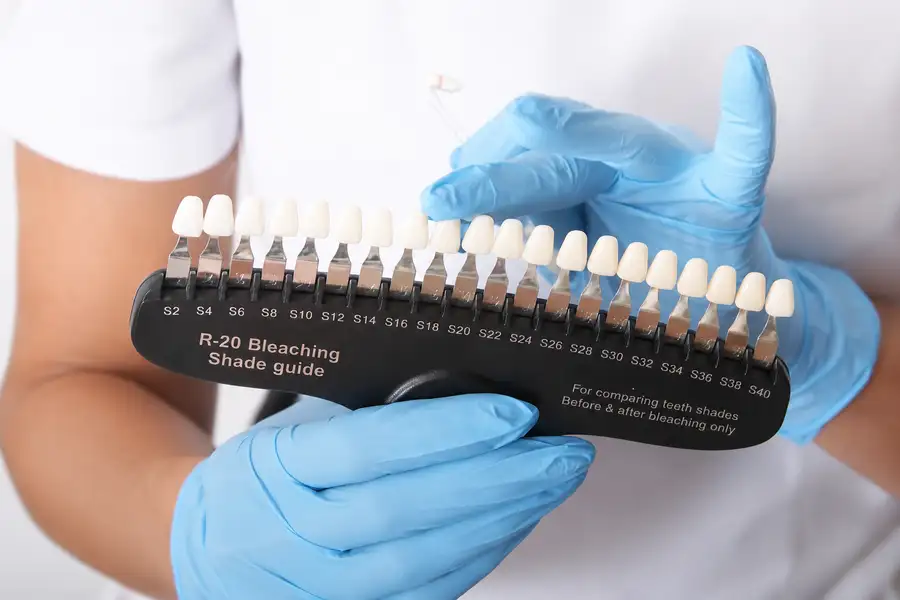
How many shades whiter can teeth become?
A fixed number of shades cannot be reliably guaranteed in advance. Someone with clearly discoloured teeth may achieve a much greater visible difference than someone whose teeth are naturally already light or contain little discolouration.
That is why we determine the starting shade with a shade guide before treatment and compare it again afterwards. This allows us to assess the colour change actually achieved instead of promising a fixed number of shades in advance.
Is the whitening result permanent?
No. Teeth can gradually become discoloured again after a whitening treatment. This is a normal process. How quickly it happens varies from person to person and is influenced by factors such as lifestyle, food, drinks, smoking and natural changes in the teeth.
A whitening treatment therefore does not permanently change the natural characteristics of the teeth and does not prevent new discolouration from developing.
A good result is therefore assessed by the colour change actually achieved after treatment. How long that colour is maintained varies from person to person.
Which active ingredients are used for teeth whitening?
Whitening gels are available in different formulations. The active ingredient is important, but it does not determine the result on its own. The formulation of the gel, contact time and treatment protocol also play a role.
Hydrogen peroxide
Hydrogen peroxide is a well-known active ingredient used for teeth whitening. It works by breaking down colour-producing compounds, making discolouration less visible.
Within the EU, specific rules apply to the concentration, sale and use of tooth-whitening products containing hydrogen peroxide.
PAP
PAP stands for phthalimidoperoxycaproic acid and is used in peroxide-free whitening formulations. It works through a different chemical process from hydrogen peroxide.
PAP is often combined with other ingredients. For that reason, the name or percentage of PAP alone should not be considered in isolation; the complete formulation and corresponding protocol matter.
Sodium percarbonate
Sodium percarbonate is a peroxide compound that can release hydrogen peroxide when it comes into contact with water. It is used in certain whitening formulations to affect colour-producing compounds.
For products containing sodium percarbonate, the complete formulation, the amount of hydrogen peroxide present or released and the product instructions are also important.
The active ingredient does not tell the whole story
Two whitening gels containing the same type of active ingredient do not necessarily perform in the same way in practice. Differences in formulation, viscosity, concentration, contact time and instructions for use can influence how a product is applied and the final whitening result.
Do not look at a single ingredient or percentage in isolation. In professional teeth whitening, the result depends on the combination of the product, the starting condition of the teeth and a correctly performed treatment protocol.
What does a whitening lamp do during a teeth whitening treatment?
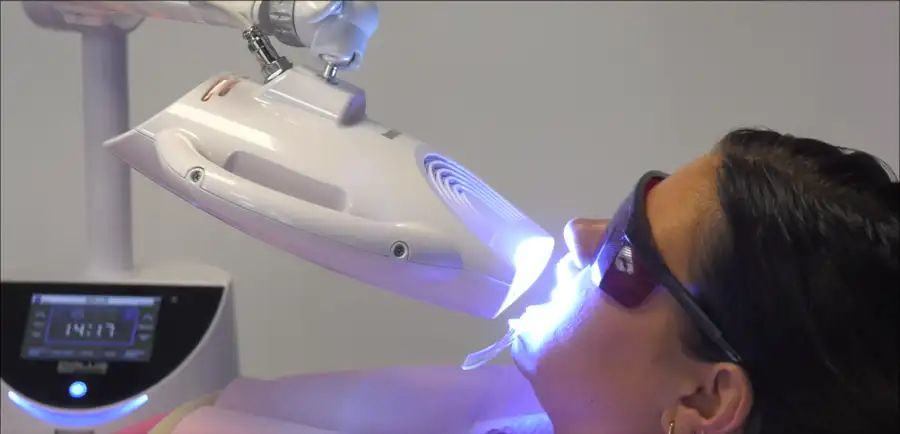
A professional whitening lamp is used during treatment as part of the complete whitening system. What matters is not simply the lamp's wattage. More important is how much usable light actually reaches the treatment area.
A lamp with a high wattage is not automatically a powerful or effective whitening lamp. What matters most is the light output that actually reaches the teeth, the exposure time and the way the lamp is used together with the whitening gel.
What does research say about light activation?
It is important to distinguish between the technical characteristics of a whitening lamp and the question of whether light activation itself produces a better whitening result. The KNMT Quality Framework for Cosmetic Dentistry states, based on the literature it cites, that the use of lamps for in-office whitening has no demonstrated advantage over light-free techniques.
This means that a whitening lamp should not be regarded as stand-alone proof of a better result. The whitening product used, the starting situation, contact time and the complete treatment protocol remain decisive.
How does X-treme Smile® work? Within our professional treatment protocols, we use a whitening lamp as part of the selected whitening system. We do not treat wattage as a stand-alone marketing claim; instead, we consider factors including light output at the treatment area, distance, even positioning, exposure time and controlled heat development.
Professional guidance: KNMT – Quality Framework for Cosmetic Dentistry.
Light intensity matters more than wattage alone
Total wattage indicates how much power a device uses or can deliver, but it does not tell you how much light actually reaches each square centimetre of the teeth.
The light intensity at the treatment surface is also known as irradiance and can, for example, be expressed in mW/cm². When exposure time is also taken into account, we refer to the total light dose, expressed in J/cm².
Distance and positioning make a difference
Even a good whitening lamp needs to be positioned correctly. If the lamp is too far from the mouth, positioned at the wrong angle or does not illuminate the treatment area evenly, less usable light may reach the teeth.
A stable position, the correct distance and even distribution of light across the full treatment area are therefore important parts of a professional whitening protocol.
Temperature also plays a role
Chemical reactions take place during a whitening treatment in which colour-producing compounds are broken down. Temperature can influence the rate at which chemical reactions occur.
Many modern whitening lamps use LED technology and are therefore often described as cold light. Even with these systems, some heat can still be generated. The aim is not to make the teeth as warm as possible, but to work under controlled conditions and avoid unwanted heat build-up.
Whitening gel, lamp and treatment time work together as a system
A whitening lamp should never be considered separately from the whitening gel being used. Different whitening products have their own formulations and protocols for use.
The active ingredient, gel formulation, light output, distance, exposure time, temperature and number of treatment rounds together form the treatment protocol.
When assessing a professional whitening lamp, look beyond wattage alone. Light output at the treatment area, exposure time, distance, even light distribution, temperature control and the combination with the whitening gel are far more relevant to a professional treatment protocol.
How is a professional teeth whitening treatment performed?
A professional teeth whitening treatment does not begin with the whitening gel; it begins with the consultation and intake. Before treatment, the starting situation, the client's expectations and any relevant considerations need to be clear.
Only then do shade assessment, preparation, product use, treatment, monitoring and aftercare follow. A consistent procedure helps professionals work carefully and compare the result before and after treatment more reliably.
A professional whitening treatment starts with the intake. Knowing when you can treat, when the protocol needs to be adapted and when you should not treat is at least as important as carrying out the practical procedure itself.
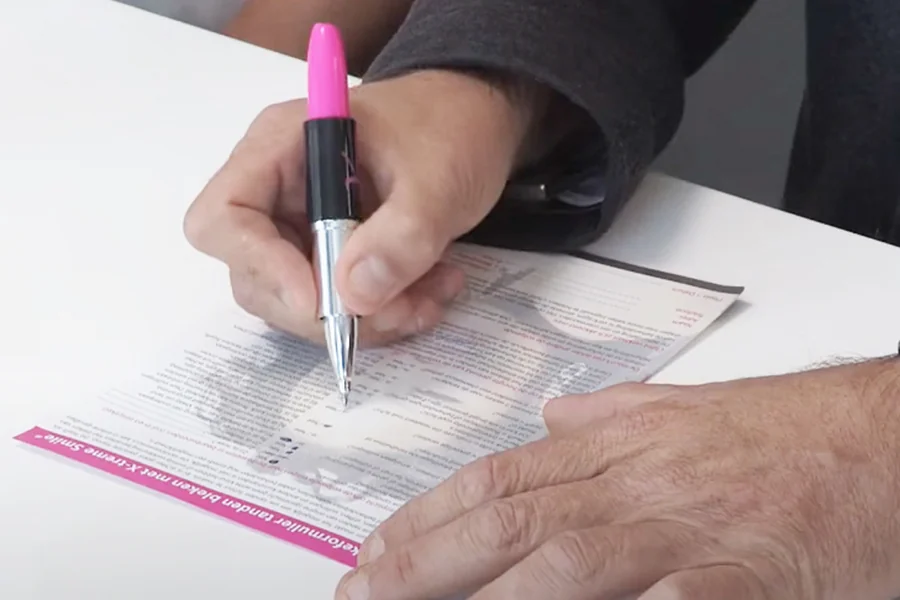
Consultation and assessment
Discuss the client's wishes and expectations and assess whether there are visible concerns that make whitening inadvisable or require a dental assessment first.
Determine the starting shade
Before treatment, determine the tooth shade using a shade guide designed for teeth whitening. This allows the result to be compared more objectively afterwards.
Prepare the client and treatment area
Maintain a clean and hygienic working environment and prepare the mouth, lips and treatment area according to the protocol for the whitening system being used. Any protective measures should be adapted to the product.
Apply the whitening gel carefully
Apply the whitening gel evenly and in accordance with the instructions for use. Using the correct amount and achieving an even application help support a consistent treatment.

Position the whitening lamp correctly
Position the whitening lamp at the correct distance and angle so that the treatment area is illuminated as evenly as possible. Then follow the prescribed treatment time.
Check between treatment rounds
A whitening treatment may consist of several rounds. Between rounds, the treatment area is checked and a decision is made about whether and how to continue.
Determine the final shade and provide aftercare
After treatment, the tooth shade is assessed again and compared with the starting shade. The client then receives clear aftercare instructions to help maintain the result as well as possible.
Why is a shade guide important?
Assessing by eye alone how much lighter the teeth have become is unreliable. Lighting conditions, photographs and even colours around the mouth can affect perception.
By using the same whitening shade guide before and after treatment under comparable conditions, the colour change can be recorded more reliably and explained more clearly to the client.
A shade guide is therefore not used to promise a particular number of shades in advance, but to compare the result actually achieved as objectively as possible.
When should teeth not be whitened?
Professional teeth whitening is not only about knowing how to perform a treatment. It also means recognising when not to treat, when additional caution is required and when a dental assessment should come first.
In a cosmetic whitening treatment, the practitioner does not make a dental diagnosis. It is, however, important to recognise deviations from the normal appearance and to ask specifically during the intake about symptoms, sensitivity, medication, allergies and other relevant factors.
If you are unsure about the condition of the teeth, gums or oral tissues, do not simply proceed with whitening. A cosmetic practitioner identifies concerns and refers when necessary; a dentist can examine, diagnose and tailor a treatment plan to the individual's dental condition.
Pain, sensitive teeth and exposed tooth necks
Unexplained tooth pain or marked sensitivity is a reason not to simply proceed with a cosmetic whitening treatment.
Additional caution is also needed with exposed tooth necks or teeth that are already sensitive. Whitening can cause temporary sensitivity or worsen existing sensitivity.
A cosmetic practitioner does not diagnose the cause. In cases of severe, unexplained or unusual sensitivity, a dental assessment is recommended first.
Unhealthy or irritated gums
Red, swollen, bleeding, damaged or clearly irritated gums require additional attention.
If there is any doubt about gum health, the cosmetic whitening treatment should be postponed and dental assessment should be recommended first.
Visible abnormalities of the teeth or oral tissues
Damage, fractures, possible caries, unusual localised discolouration or other abnormalities of unclear cause should not be diagnosed by a cosmetic practitioner.
If anything observed during the intake falls outside the normal appearance, do not proceed until it is clear that a cosmetic whitening treatment can be carried out responsibly.
Medication and light sensitivity
Some medicines can cause photosensitivity or increased sensitivity to certain forms of light. This can occur, for example, with certain antibiotics, diuretics and other medicines, but it does not automatically apply to every medicine within those groups.
Warnings for photosensitising medicines often relate to sunlight or UV radiation. A professional LED whitening lamp is therefore not automatically the same type of exposure. Even so, when a whitening lamp is used it is sensible to ask about medication and known light sensitivity during the intake.
Medication use is therefore not automatically a contraindication to teeth whitening. If in doubt, check the patient information leaflet or official information for the medicine as well as the instructions for the whitening system being used. If there is an explicit warning about light exposure, or if uncertainty remains, postpone treatment and consider advising consultation with a doctor or pharmacist.
Allergies and hypersensitivity
During the intake, ask about known allergies and previous reactions to whitening products, oral-care products or materials used during treatment.
If there is a known allergy or previous adverse reaction, first check whether the relevant ingredient or material is present in the product being used.
If this is unclear, do not start treatment until it has been established.
Active or recent cancer treatment
Chemotherapy, radiotherapy and other cancer treatments can affect, among other things, the oral mucosa, saliva production, sensitivity, oral health and resistance to infection.
Teeth whitening is a cosmetic, non-essential treatment. During or following recent cancer treatment, we therefore take a cautious approach and recommend consultation with the treating doctor and/or dentist first.
We deliberately do not apply one general fixed waiting period, because recovery and medical circumstances vary by treatment and by individual.
Pregnancy and breastfeeding
What do professional guidelines say?
The American Dental Association (ADA) emphasises that necessary preventive, diagnostic and restorative dental care can be safely provided during pregnancy. This distinction matters because necessary oral healthcare should not be confused with an elective cosmetic treatment.
In its general information on teeth whitening, the ADA does not list pregnancy or breastfeeding as separate absolute contraindications. The absence of such a specific statement does not, however, mean that cosmetic whitening during these periods is necessary or proven to be advisable.
The Dutch KNMT Quality Framework for Cosmetic Dentistry describes external whitening as a non-invasive cosmetic treatment and emphasises a healthy mouth, careful prior assessment, good information and safe practice. Pregnancy and breastfeeding are not listed as separate absolute contraindications in its section on whitening.
Our position at X-treme Smile®
At X-treme Smile®, our advice is clear: do not whiten teeth during pregnancy or while breastfeeding.
Teeth whitening is a purely cosmetic treatment and can be postponed. From our own professional perspective, we deliberately apply the precautionary principle during this period. The body has other priorities during pregnancy and breastfeeding, and there is no need to carry out an elective cosmetic treatment at that time.
We also want to avoid unnecessary uncertainty afterwards. If a pregnancy complication occurs, a pregnancy ends prematurely or health problems later arise in the baby, we want to avoid a cosmetic whitening treatment being incorrectly regarded as a possible cause.
We are explicitly not saying that teeth whitening causes such problems. This is our own deliberately precautionary policy for a treatment that is not medically necessary.
Our advice: postpone teeth whitening until after pregnancy and the breastfeeding period.
Professional guidance: ADA – Pregnancy and KNMT – Quality Framework for Cosmetic Dentistry.
Crowns, veneers and composite: what do they mean for whitening?
Crowns, veneers, composite fillings and other tooth-coloured restorations are generally matched to the tooth shade at the time they are placed. Over the years, natural teeth can continue to become discoloured, while restorative materials do not change in the same way and may also age or discolour differently.
A colour difference can therefore develop over time. If the natural teeth have become darker than, for example, a crown or veneer, whitening the natural teeth may actually help reduce the colour difference and bring them closer again to the shade of the existing restorations.
It is important to remember that existing crowns, veneers and composite restorations do not whiten in the same way as natural teeth. If the natural teeth become lighter than the restorations, a new colour mismatch may occur. The starting situation and desired final result should therefore be assessed and discussed carefully in advance.
Restorations are therefore not automatically a reason not to whiten. What matters is how the shade of the natural teeth compares with the existing restorations and what degree of colour change is realistic and desirable.
Realistic expectations are part of a good intake
Not every set of teeth can reach the same final shade. The natural tooth shade, amount and type of discolouration, age of the teeth and any restorations all influence how much visible improvement is possible.
White spots, fluorosis and certain types of discolouration that developed while the teeth were forming may also respond differently from surface staining caused, for example, by coffee, tea or smoking.
If a client's expectations are unrealistic, this should be discussed before treatment. A professional should therefore not promise a fixed number of shades whiter in advance.
Recognising, diagnosing and treating: know your professional role
Anyone carrying out cosmetic whitening treatments without dental authority does not make a dental diagnosis. During an intake, however, you can recognise deviations from the normal appearance and gather relevant information.
If you notice anything unusual, the client has symptoms, or you are uncertain about the condition of the teeth, gums or oral tissues, do not carry out the cosmetic treatment and advise the client to consult a dentist first.
For a dentist, the situation is different. A dentist can examine the dental condition, make a diagnosis and develop a treatment plan based on that assessment. If teeth whitening forms part of that plan, the dentist can tailor the treatment to the individual patient's dental situation.
Professional practice also means knowing where your own expertise and authority begin and end. A cosmetic practitioner recognises concerns, screens clients and refers when in doubt; a dentist can diagnose and tailor the dental treatment plan accordingly.
Which rules apply to professional teeth whitening?
Which whitening products you may use depends, among other things, on the product's composition and your professional role. Within the European Union, specific rules apply to tooth-whitening products that contain hydrogen peroxide or release hydrogen peroxide during use.
For whitening products, it is not only added hydrogen peroxide that counts. Substances that release hydrogen peroxide during use are also subject to the legal concentration limits.
Up to and including 0.1% hydrogen peroxide
Tooth-whitening products that contain or release no more than 0.1% hydrogen peroxide may be sold freely to consumers in the Netherlands.
These products can therefore also be used in cosmetic whitening treatments outside a dental practice, provided the product complies with the applicable product and cosmetics legislation and is used according to its instructions.
More than 0.1% up to and including 6% hydrogen peroxide
Stricter rules apply to tooth-whitening products that contain or release more than 0.1% and no more than 6% hydrogen peroxide.
These products may only be sold to dentists. For each treatment cycle, the first use must be carried out by a dentist or under their direct supervision. They must also not be used on persons under 18 years of age.
Peroxide-releasing ingredients also count
Some whitening products do not contain hydrogen peroxide directly but contain ingredients that can release hydrogen peroxide during use. The legislation therefore considers the amount of hydrogen peroxide present in the product or released from other compounds.
Sodium percarbonate is one example. When assessing such a product, it is not only the name of the ingredient that matters, but the amount of hydrogen peroxide that the final product actually contains or releases.
Always work with products whose composition, intended use and instructions are clear, and check that the product is compatible with what is legally permitted for your professional role.
This information describes the situation in the Netherlands and the European Union. Laws and regulations may differ by country and may change over time.
Official sources: NVWA – teeth whitening products and EU Cosmetics Regulation, Annex III.
Learning professional teeth whitening
Professional teeth whitening requires more than simply learning how to apply whitening gel. A good practitioner understands why particular choices are made and can apply that knowledge to different practical situations.
At X-treme Smile®, we therefore consider it just as important that you learn when you can treat, when a protocol needs to be adapted and when a treatment should not be performed.
Consultation and intake, shade assessment, recognising concerns, product use, hygiene, treatment time, whitening lamps, checks between treatment rounds, expectation management and aftercare are all part of professional practice.
For cosmetic professionals
A cosmetic practitioner learns not only the practical technique, but also how to screen clients carefully, recognise deviations from the normal appearance and know when treatment should be postponed or referral to a dentist is appropriate.
For dental professionals
For dentists and other appropriately authorised dental professionals, teeth whitening may form part of a broader treatment plan. Examination, diagnosis and the individual's dental condition can then be taken into account when selecting and adapting the treatment protocol.
Support does not end after the course
Many questions only arise once you begin working independently with clients. That is why we consider post-course support important. If you encounter a situation later that you are unsure about, you can contact X-treme Smile® for support and practical advice.
Teeth Whitening Course for Professionals
In the X-treme Smile® Teeth Whitening Course, you learn step by step how to work professionally with consultation and intake, shade assessment, whitening products, whitening lamps, treatment protocols, safety and aftercare.
The course combines theory with practical application and has been developed from years of hands-on experience and a dental background.
View the Teeth Whitening CourseProfessional teeth whitening products
Alongside professional knowledge and training, X-treme Smile® offers professional products and equipment for use within an appropriate treatment protocol.
Whitening gels
View professional whitening products for different treatment protocols.
View whitening gels →Whitening lamps
Professional whitening lamps for salon and dental-practice use.
View whitening lamps →Starter kits
Complete packages for professionals who want to start offering teeth whitening.
View starter kits →Knowledge grounded in dental education and practical experience
X-treme Smile® has been active in professional teeth whitening since 2010. Over the years, we have built extensive hands-on experience with cosmetic whitening treatments, products, equipment and the training and support of professionals.
We combine that practical experience with educational backgrounds in areas including dental assisting, dental technology and dental hygiene. This means we approach teeth whitening not only from the practical procedure itself, but also from the perspective of anatomy, dental condition, safety and professional decision-making around treatment.
This combination forms the basis of our courses, treatment protocols, product knowledge and the professional information in this knowledge base.
- Active in professional teeth whitening since 2010
- Dental education background
- Hands-on experience with cosmetic whitening treatments
- Training and support for professionals
- Personal support after the course