Nederlands
 Français
 Deutsch


What problems can occur during a teeth whitening treatment?
Professional teeth whitening usually runs smoothly when you work with suitable products, follow the correct treatment protocol and select clients carefully. However, teeth whitening problems can still occur during or after treatment.
The most important thing is knowing what you are seeing, what may be causing it, and when you need to adjust or stop the treatment.
Sensitive teeth
A client may experience sensitivity during or after treatment. This is not necessarily caused by the whitening gel alone.
The heat generated by the whitening lamp may also play a role. Teeth contain nerve tissue within the pulp, and some clients are more sensitive to temperature changes than others.
This can result in short, sharp sensations or an aching sensitivity during treatment.
Do not only check the gel, but also consider:
lamp position → distance from the teeth → heat development → treatment time → client response
If the sensitivity becomes clearly uncomfortable or painful, do not automatically continue simply because additional treatment rounds were planned.
The treatment protocol provides guidance, but the client’s response should always be taken into account.
Whitening gel should only be applied to the teeth
Whitening gel should be applied carefully and in a controlled manner to the tooth surface. It should not unnecessarily come into contact with the gums, lips or other soft tissues.
There are several reasons for this.
Soft tissues such as the gums and oral mucosa are considerably more sensitive to direct contact with products than the hard tooth surface. A client may also have an unknown sensitivity or allergy to an ingredient, even if there were no previous indications.
This is why precise application is important and why you should not use more product than necessary.
Products containing hydrogen peroxide also require specific gum-protection protocols.
If gel comes into contact with soft tissue, or if redness, swelling, a burning sensation or another unexpected reaction occurs, stop the treatment and follow the instructions for the product concerned.
Lips can become dry or sensitive
During treatment, the cheek retractor keeps the lips and cheeks away from the treatment area. Especially during several treatment rounds, this can cause dryness or tension around the mouth.
For this reason, we use vitamin E sticks for the lips.
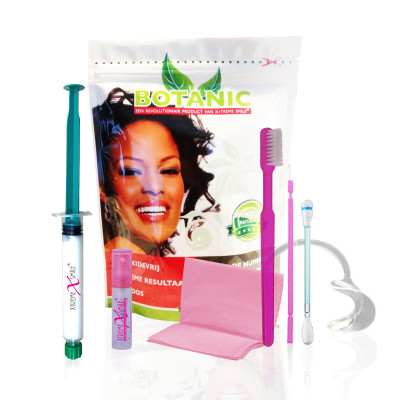
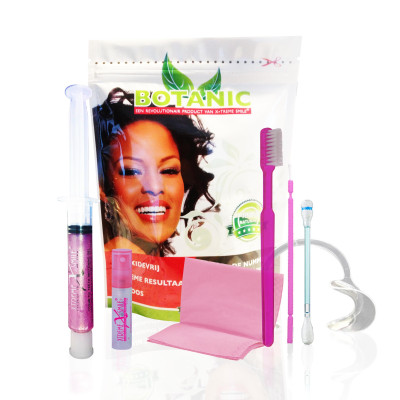
These are included in our single-client treatment kits and are also available separately from X-treme Smile.
Keep saliva away from the whitening gel
Saliva should be kept away from the whitening gel as much as possible during treatment.
If saliva comes into contact with the gel, it can dilute, move or contaminate it, reducing your control over the treatment and potentially affecting the result.
A suitable cheek retractor, correct client positioning and regular monitoring are therefore important.
Ask the client to talk as little as possible during a treatment round and regularly check that saliva is not reaching the treated area.
Preferably treat the client in a reclined position
We recommend treating the client in a reclined position.
This gives the practitioner a better view of the teeth and greater control over:
gel placement → saliva → cheek retractor position → whitening lamp position
If the client is sitting too upright, a thinner gel may run or move more easily during treatment.
A stable reclined position therefore makes precise application and monitoring easier.
The whitening gel runs or moves
The viscosity differs between whitening gels.
X-treme Smile Pink has a thicker consistency, while X-treme Smile Booster is thinner.
With a thinner gel, controlled application is particularly important. Do not use an excessive amount of product and make sure the client is positioned correctly before starting.
More gel does not automatically produce a better whitening result. Using too much can actually make it more difficult to keep the gel neatly on the tooth surface.
If the gel moves, check:
amount of gel → client position → cheek retractor → saliva → application technique
The result is less than expected
If a client does not become as white as expected, this does not automatically mean something has gone wrong.
As explained in our separate FAQ about whitening results, one important factor is the amount of discolouration that can actually respond to whitening.
You should also check the complete treatment protocol:
whitening gel → amount → treatment time → number of rounds → whitening lamp → distance → position → product storage
Do not automatically use more gel or extend the treatment simply because the result is less than expected.
The whitening lamp is not positioned correctly
The whitening lamp should illuminate the treatment area as evenly as possible.
If the lamp is positioned too high, too low, too far to the left or right, or at the wrong angle, the light may not be distributed evenly across the teeth.
Before every treatment round, check:
height → distance → angle → centring
Moving the lamp closer to the teeth in the hope of achieving a faster or stronger result is not automatically better. A shorter distance may also increase the amount of heat experienced by the client.
Always follow the protocol for the specific whitening lamp you are using.
A product has been stored incorrectly
Product storage can also affect a treatment.
Whitening products should be stored according to the instructions on the label and preferably in a cool, dark place, protected from direct sunlight and high temperatures.
A product that has been stored incorrectly for a longer period may still look completely normal even though its quality or performance has been affected.
If you are unsure about the condition of a product, do not simply use it on a client.
When should you stop?
There is a difference between a mild, temporary sensation and clear pain, irritation or an unexpected reaction.
Stop or interrupt the treatment in situations such as:
- clear pain;
- strong or increasing sensitivity;
- burning or irritated soft tissue;
- swelling or a possible allergic reaction;
- a situation you cannot properly explain;
- any doubt about whether it is appropriate to continue.
Professional treatment is not only about knowing how to perform teeth whitening, but also recognising when you need to adjust or stop.
In short
Many teeth whitening problems can be prevented by working carefully and maintaining control throughout the treatment:
careful client selection → correct reclined position → cheek retractor → saliva control → correct amount of gel → correct lamp position → monitoring heat and comfort → correct treatment protocol
During treatment, do not focus only on the desired whitening result. Pay close attention to how the client is responding throughout the procedure.
Professional teeth whitening is not simply a matter of applying gel and switching on a lamp. It requires continuous observation, control and appropriate adjustment when necessary.