Nederlands
 Français
 Deutsch


Why does my tooth gem keep falling off?
If your tooth gem keeps falling off, this does not automatically mean that the adhesive is faulty. Retention depends on the entire application process: cleaning, etching, Primer, bonding, curing, placement of the jewelry and the client’s bite.
If tooth gems repeatedly come off too quickly, it is important to review the full protocol step by step.
1. The tooth was not cleaned properly or kept completely dry
For reliable bonding, the tooth surface must be clean and truly dry. Saliva, moisture, plaque or other contamination can significantly reduce adhesion.
After etching, removing the etchant, rinsing and drying, you should see a frosty white, matte area on the treated enamel. This is an important indication that the enamel surface has been properly prepared.
After this point, the surface must remain dry.
If saliva touches the etched area again, for example because the client keeps talking or pushes saliva forward from behind the teeth with their tongue, the surface has been contaminated again. You should then repeat the relevant preparation step according to the protocol before continuing.
A practical way to help the client is to ask them to:
- place their tongue against the roof of the mouth;
- keep their mouth still during this part of the treatment;
- avoid talking until the tooth gem has been positioned and cured.
It is worth explaining why: saliva contamination can directly affect how long the crystal stays attached. Clients usually cooperate much better when they understand that talking or moving during this stage can compromise the bond.
2. Blue Etch was not used correctly
Etching prepares the enamel for adhesion. Blue Etch should be applied precisely to the intended bonding area and used according to the prescribed protocol.
After the correct application time, the product should be removed, the tooth thoroughly rinsed and then dried.
A correctly etched surface should normally have a frosty white, matte appearance.
If you do not see this effect, or if the surface has become wet again due to saliva, do not simply continue with Primer and Glue.
Longer etching or using more Blue Etch does not automatically create a stronger bond. Always follow the recommended etching time.
3. Saliva contamination after etching
This is one of the most underestimated reasons why tooth gems fail.
A tooth may have been etched perfectly, but as soon as saliva reaches the prepared area, adhesion may be compromised.
This can happen when:
- the client talks;
- the tongue presses against the back of the teeth;
- saliva moves forward around the teeth;
- the working area is not kept sufficiently dry.
If this happens, do not simply continue with Primer and Glue. Restore the preparation according to the protocol before proceeding.
A cheek retractor, good moisture control and clear instructions to the client can make a major difference.
4. Primer was skipped or applied incorrectly
Primer forms the connection between the prepared enamel surface and the bonding layer.
If this step is skipped, used incorrectly or applied to a moist or contaminated surface, the bond may become less reliable.
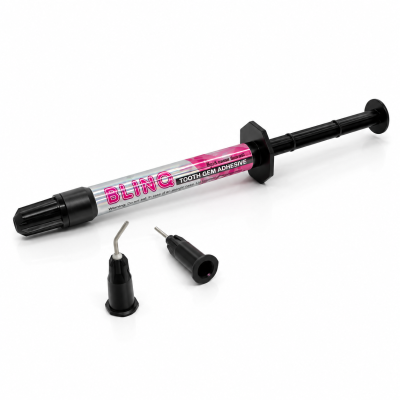
When using the BlinQ* system, use Blue Etch, Primer and Glue in the correct order.
5. Too little or too much bonding material was used
The tooth gem needs sufficient contact with the bonding material. Too little material may result in insufficient bonding surface.
Using a large amount of Glue is not automatically better. An excessively thick or irregular layer can make placement and finishing more difficult.
Use enough material for reliable attachment and create a smooth, neat finish around the tooth gem.
6. The bonding material was not cured sufficiently
A suitable curing light is essential.
Pay attention to:
- sufficient light intensity;
- correct distance from the tooth;
- correct angle of the curing light;
- adequate curing time;
- sufficient light exposure around the tooth gem.
A curing light that does not provide enough power, is poorly charged or is positioned incorrectly may result in incomplete curing.
7. The tooth gem position is not ideal
Not every position on every tooth is equally suitable.
Tooth gems placed on the lower teeth often have a shorter retention time than those on upper teeth. There is usually less space and more contact with the opposing teeth, tongue, food and chewing forces.
Always check the client’s bite before placement.
8. The tooth gem is large or exposed to mechanical forces
A larger or more prominent tooth gem can be hit more easily during eating and biting.
Examples include:
- hard apples;
- carrots;
- baguettes;
- crusty rolls;
- other hard or crunchy foods.
If the gem is repeatedly subjected to direct mechanical forces, the chance of it coming loose increases.
9. The tooth surface is not suitable
The most predictable adhesion is generally achieved on healthy natural enamel.
Crowns, veneers, composite restorations or damaged enamel may react differently to the bonding system.
Always assess the actual tooth surface before placing the jewelry.
10. The tooth gem does not have a suitable bonding surface
The back of the jewelry also matters.
Not every random stone, nail-art crystal or decorative item is automatically suitable for professional tooth gem bonding.
A tooth gem should have a bonding surface suitable for professional adhesion.
11. The bonding products were stored incorrectly
Blue Etch, Primer and Glue must be stored correctly.
Temperature, UV exposure and prolonged sunlight can affect the products.
Keep them within the temperature range shown on the label and store them in a closed, light-proof container. Close all products immediately after use.
12. Products from different systems are being mixed
A professional bonding system is developed as a complete protocol.
Randomly combining Etch, Primer and Glue from different systems can make the result less predictable.
When using BlinQ*, preferably use Blue Etch, Primer and Glue together according to the BlinQ protocol*.
My tooth gems keep coming off – what should I check?
Check the process systematically:
cleaning → etching → frosty white surface → complete moisture control → no saliva contamination → Primer → Glue → placement → curing → finishing → bite → product storage.
The stage between etching and bonding deserves particular attention. A perfectly prepared enamel surface can become contaminated within seconds if the client talks or pushes saliva towards the teeth with their tongue.
So do not hesitate to ask the client to keep their mouth still and place their tongue against the roof of their mouth. It may seem like a small detail, but it can make a significant difference to how long the tooth gem stays in place.